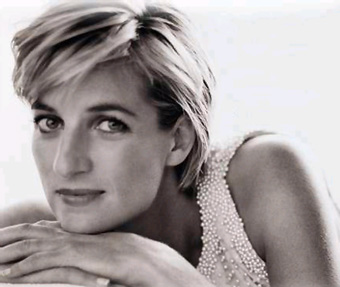
Disculpen la falta de traducción. De mi revista favorita (The Economist):
Carnival queen
Aug 23rd 2007
From The Economist print edition
A decade after her death, Princess Diana's legacy is not the one that might have been expected
IN 1712, aged two, Samuel Johnson was brought to London by his mother. Almost blind and ill with scrofula, he was taken to St James's Palace to be "touched" by Queen Anne. Rationalist though he was, Johnson always wore the "touch piece" bestowed on him by the queen, whom he later hazily recalled as "a lady in diamonds and a long black hood".
The practice of "touching" the sick, with its potent associations of magic and semi-divinity, flourished among the medieval and renaissance kings, but seemed to have died out by the beginning of the 19th century. Yet it lived again, until almost the end of the 20th, in the shape of Princess Diana, albeit with the long black hood exchanged for a little black dress.
During her short, sad life, Diana was seen as a scandalously modern princess; after her sadder death, and as its tenth anniversary approaches next week, she has been enlisted as a posthumous poster girl for various progressive causes. "She wasn't seen as posh. She was one of the people," argues Time magazine, hailing her as "the princess [who] transformed a nation". She wasn't—and she didn't. Beyond her roles as fairy-tale princess and floundering, suffering divorcee, Diana's appeal rested in part on an ancient archetype: the monarch who walks among the people, working miracles, in her case among the lepers, AIDS patients and maimed children she unsqueamishly embraced. And just as her draw was in part atavistic, the legacy of her death has proved a surprisingly reactionary one.
Plus á§a change
Primitive fears of mortality; obscure feelings of guilt; globalised media; a hot summer: all that, and a lot else besides, contributed to the hysteria of "Diana week", between the crash in Paris and the surreal funeral. The precise chemistry is still unfathomable; like many great events, the maelstrom is remembered differently by different people. But at least one interpretation that seemed plausible during those strange days in London now looks conclusively wrong. At the time, glum monarchists and a few optimistic republicans thought they heard the rumble of tumbrils emanating from the volatile mob outside Buckingham Palace. Yet five years later, huge and loyal crowds turned out for the queen mother's funeral, and for the queen's Golden Jubilee. Ten years on, the Windsors' poll ratings are rosy; Prince Charles has married the once-reviled Camilla; no one talks much any more about the crown skipping over his head to land straight on his elder son's.
Instead of heralding a republic, that week is now often said to have saved the monarchy, by forcing it to emulate the mourned, modern princess. In fact, the royal family started to change before Diana became part of it: the queen had begun to "let in daylight upon the magic", which the original Bagehot warned against, as early as a royal television documentary of 1969. With hindsight, the public seems to have lamented Diana as much because she was one of the royals as because she was estranged from them. At a distance, the masses look less insurrectionist than conservative—and were quickly salved when the queen walked amongst them. (Only a traditional people could have got quite so worked up about how high a flag flew over a palace.) Seeming to challenge the status quo, the moment ultimately reinforced it—and not only in respect of the monarchy.
As well as shaking up the throne, Diana's death has been regarded as the embodiment or spark of broader shifts in Britain's politics and personality. Because of her colour-blind taste in men and the diversity of the crowds, August 1997 has been seen as a milestone in the evolution of a multi-ethnic nation—mostly by people who hadn't noticed that Britain had already become one. In part because they coincided with the advent of Tony Blair's New Labour government, and the ejection of a Conservative one, the weeping and hugging in the Mall have been seen as evidence of a general longing to be part of something bigger: of a rejection of social atomisation, an embrace of compassion and communitarianism. Like the fervent hopes Mr Blair aroused, that longing, if it existed, seems to have faded.
Still more ambitiously, "Diana week" is extolled as the time when Britain's upper lip definitively relaxed. That notion overestimates both how stiff the lip was before—Britain was never quite the emotionally deformed place of lore—and how flaccid it has become since. Even now the British do not routinely ululate at funerals; subsequent and greater tragedies, such as the terrorist attacks of July 7th 2005, have elicited touchingly restrained responses. In so far as that weird week related to the country's emotional life, it was as a safety valve rather than a catalyst.
The exception to that rule involves the institution that once seemed most likely to be changed by Diana's death: the press. Reviled, like the Windsors, for their contribution to her fate, the media refrained from intruding in her two sons' lives—but only temporarily. Now grown up, sometimes sporting girlfriends and inadvisable fancy-dress costumes, they are considered fair game. The commercial and technological forces that made their mother a hyperstar have made celebrity yet more coveted, and privacy still less respected. But Britain's tabloid newspapers did draw another lesson from the post-Diana frenzy: the power and popularity they could muster by launching sentimental crusades, such as the recent one waged over the disappearance of a little girl in Portugal. The mood these crusades whip up, like that in London ten years ago, can feel emotionally coercive, even intimidating, to those who don't entirely share it.
Had she lived, Diana would eventually have become less beautiful, less interesting, perhaps less unhappy. By dying, she immortalised herself as the "queen of hearts". But in truth she became a carnival queen: monarch of a temporary disorder that, when it passed, left the old order intact, or stronger.